Monday, December 28, 2015

Wild Accusations Torment Christians in Laos

Wild Accusations Torment Christians in Laos


September 24, 2015
Unless an appeals court overturns a ruling, praying for the sick is illegal in Laos. (File Photo)
A Christian in Laos accused of being an "illegal doctor" because he prayed for a sick woman who later died was jailed for nine months without treatment for his diabetes. Last week, six months after he was released pending appeal, he died from his condition.
Tiang Kwentianthong was one of five Christians arrested in Saisomboon village, Atsaphangthong District, on June 24, 2014 after an aging woman who had long been ill asked them to pray for her. He was 61.
"While awaiting the verdict in prison in Savannakhet Province for almost nine months [before sentencing on Feb. 12 of nine months in prison and hefty fines], Mr. Tiang continued to suffer severe diabetes," said an advocate for Human Rights Watch for Lao Religious Freedom (HRWLRF). "Mr. Tiang requested permission to be treated for his worsening diabetic condition, but the prison officials denied his request."
The advocacy group helped win their freedom pending appeal on March 20, and immediately after his release from prison, Tiang began receiving treatment for his severe diabetic condition, said the advocate, who requested anonymity. The People's Court of Savannakhet Province had found the Christians guilty of acting "without proper medical authorization."
The Christians filed their appeal on March 6 as the verdict had no factual and legal basis, the advocate said. The woman they had prayed for was later admitted to a hospital, where she received treatment before she died. The appeals court was supposed to deliver a ruling within 45 days of receiving the petition, but it had not done so at the time of Tiang's death more than six months later.
"The HRWLRF demands that the Lao government, along with the Savannakhet provincial prison officials, take responsibility for the death of Mr. Tiang, who was arrested and imprisoned illegally and who was denied request for medical treatment for his worsening diabetic condition," the advocate said.
Arrested along with Tiang were pastor Kaithong Khounphaisan, Puphet Phanmalaithong, Muk Boulakham and Hasadee Thammathoun. Two of the other prisoners also suffer from diabetes, and two others had kidney infections requiring medications that were denied them in prison, the advocate said.
"Two were bordering on kidney failure," he said. "So they spent about a month to two months just to recover from the very bad health conditions they had, and then after that they continued to start holding worship service again in their home."
Police have continued harassing the Christians, demanding payment of the fines even though the case remains under appeal, and last month about 20 officers surrounded the house where the church was meeting on a Sunday morning. Ignoring the threat of arrest, the group decided to continue worshipping. When they came out an hour later, the police were gone, the advocate said.
"They now have the freedom to meet in their homes, and also they're traveling to new locations, and other people are coming to know Christ," he said. "They have planted two new churches."
Church growth in Laos threatens village officials' sense of control. (File Photo)
Until there is an appeals court ruling, though, any Christian in Laos who prays for the sick could be subject to the charge of illegal medical practice, he said. Another area of Savannakhet Province saw an even more draconian measure. Becoming Christian left an entire family open to the charge of angering murderous village spirits. A village chief who believed their conversion was responsible for local spirits visiting illness and death on his daughter illegally sentenced the family to death.
The head of Atan village in Nong District, identified only as Bounchen, sought to execute the Christian family on Aug. 31, but a Communist Party official in the area managed to stop him, the HRWLRF leader said. A village religious affairs official identified only as Pousone planned to help Bounchen carry out the illegal verdict and sentence.
The head of the family, identified only as Lahoie, and six relatives embraced Christ in April. When Bounchen's daughter died in the middle of August, the village chief blamed the Christians.
"He believed that her death was caused by angry village spirits who were oppressed by the Spirit of Jesus that the Christians brought into the village when they embraced the Christian faith," the advocate said.
Bounchen called an obligatory meeting in which village households concluded the Spirit of Christ was evil and harmful, and that therefore the Christians had to be killed to appease the village spirits. Bounchen, Pousone and the village security force tried unsuccessfully to get the backing of the area Communist Party official for the execution of Christians.
Unable to execute them, on Sept. 4 village officials led by Bounchen went to the Christian family's home and seized a pig and a goat worth $85 and $45 respectively, the equivalent of about two months' wages, according to the HRWLRF advocate. The officials slaughtered and ate the animals.
"After the confiscation of the pig and goat, a Christian leader, Pastor Agom from Nong District, reported the incident of their death penalty and the confiscation of their animals to the Nong District's Religious Affairs Office," the advocate said. "The Religious Affairs Office has yet to bring actions against the Atan village officials who acted in violation of the law."
The HRWLRF is urging the Lao government to respect the right of the Lao people to religious freedom and the accompanying rights as guaranteed in the Lao constitution and the U.N. International Covenant on Civil and Political Rights, ratified by Laos in 2009. The Covenant upholds the individual's right to adopt a religion/belief of choice, as well as the right to manifest that religion/belief in a corporate worship (Article 18).
"Additionally, the HRWLRF urges the Lao government to punish the Atan village officials who acted unlawfully, thus bringing harm to the lives of the citizens of Atan village who are of Christian persuasion," the advocate said. "The HRWLRF furthermore demands that the village officials be made to compensate for the loss of the animals of the Christian family."
To help indigenous missionaries meet needs, you may contribute online using the form below, or call (434) 977-5650. If you prefer to mail your gift, please mail to Christian Aid Mission, P.O. Box 9037, Charlottesville, VA 22906. Please use Gift Code: 730CFL. Thank you!

Prayer Cover


Christians pray for victory over forces of darkness in Laos, where political, religious and societal powers oppress Christians. Making up slightly more than 3 percent of the population of the communist country, Christians face hostilities from Buddhists and animists, often a syncretistic mix of the two. Local officials uphold the status quo; in Khounkham District in Khammouane Province, five policemen in Nong-hang village on Sept. 2 arrested two men for spreading the Christian faith. Bountheung Phetsomphone, a Christian leader from another province, was visiting a Christian identified only as Neuy, and a Christian family invited them to their home to encourage and prayer for them. As they were eating lunch with the host family, the officers stormed in, arrested the two visitors and incarcerated them at Khounkham District prison. Both Christians are married, and each has three children. An indigenous ministry group assisted by Christian Aid Mission advocated for their release, and they were freed on Sept. 12. (File Photo)

Saturday, December 26, 2015

Oregon Gunman Tells Christians They Will See God in ‘One Second’

Oregon Gunman Tells Christians They Will See God in ‘One Second’

shooter1
A gunman carrying four weapons — three pistols and a rifle — entered an Oregon college Thursday and opened fire on several victims. Ten innocent people were killed and several others were wounded in the mass shooting.
Brady Winder, a 23-year-old student, said people were “scrambling “like ants” when the gunman opened fire around 10:38 a.m.
The gunman, whose name we have chosen not to share, was later shot and killed in a shootout with police outside one of the classrooms, according to Douglas County Sheriff John Hanlin.
shooting1
Students told authorities the gunman entered one classroom told everyone to get down the floor before having them stand one at a time asking them if they were a Christian. One witness told reporters she saw the gunman asking a teacher about religion before shooting them in the head.
At least one witness told CNN the shooter was targeting Christians:

“[He started] asking people one by one what their religion was. ‘Are you a Christian?’ he would ask them, and if you’re a Christian, stand up. And they would stand up and he said, ‘Good, because you’re a Christian, you are going to see God in just about one second.’ And then he shot and killed them,”

Stories of extraordinary heroism are starting to emerge. Army veteran Chris Mintz risked his own life to save others by running towards the gunman. Mintz was shot seven times and was still in surgery for his injuries earlier this morning.
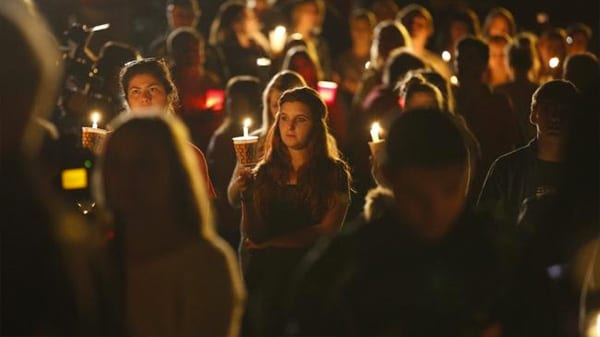
Thousands of people attended a vigil in an Oregon park last night to pay tribute to those who lost their lives in this tragic school shooting.
vigil
President Obama quickly responded with a plea for more gun control, calling America “the only advanced country on Earth that sees these kind of mass shootings every few months.”
Please join us in praying for the victims and families attacked in this terrible shooting.

Syrian Christian Boy Crucified by ISIS

Syrian Christian Boy Crucified by ISIS

church
Christians in Syria have suffered at the hands of ISIS because they have refused to denounce their faith. They’ve endured being robbed at checkpoints, many have been tortured, raped or sold to the sex slave market. On August 28 in a village near Aleppo, Syria, twelve Christians were brutally murdered including a 12-year-old boy and his ministry leading father.
Christian Aid wrote,
“The relatives said ISIS militants on Aug. 7 captured the Christian workers in a village whose name is withheld for security reasons. On Aug. 28, the militants asked if they had renounced Islam for Christianity. When the Christians said that they had, the rebels asked if they wanted to return to Islam. The Christians said they would never renounce Christ.
The 41-year-old team leader, his young son and two ministry members in their 20s were questioned at one village site where ISIS militants had summoned a crowd. The team leader presided over nine house churches he had helped to establish. His son was two months away from his 13th birthday.
In front of the team leader and relatives in the crowd, the Islamic extremists cut off the fingertips of the boy and severely beat him, telling his father they would stop the torture only if he, the father, returned to Islam. When the team leader refused, relatives said, the ISIS militants also tortured and beat him and the two other ministry workers. The three men and the boy then met their deaths in crucifixion.”
“All were badly brutalized and then crucified,” the ministry leader said. “They were left on their crosses for two days. No one was allowed to remove them.”
The ministry director had asked the ministry leaders to leave for their safety, but they all insisted on staying. They felt like God wanted them to stay and share the gospel.
“The martyrs died beside signs the ISIS militants had put up identifying them as “infidels.”
Eight other ministry team members, including two women, were taken to another site in the village that day (Aug. 28) and were asked the same questions before a crowd. The women, ages 29 and 33, tried to tell the ISIS militants they were only sharing the peace and love of Christ and asked what they had done wrong to deserve the abuse. The Islamic extremists then publicly raped the women, who continued to pray during the ordeal, leading the ISIS militants to beat them all the more furiously.
As the two women and the six men knelt before they were beheaded, they were all praying.
“Villagers said some were praying in the name of Jesus, others said some were praying the Lord’s prayer, and others said some of them lifted their heads to commend their spirits to Jesus,” the ministry director said. “One of the women looked up and seemed to be almost smiling as she said, ‘Jesus!'”
After they were beheaded, their bodies were hung on crosses, the ministry director said, his voice breaking. He had trained all of the workers for their evangelistic ministry, and he had baptized the team leader and some of the others.”
Syrian Christians and indigenous missionaries are in great danger every day. Pray for surviving families, for the work of the gospel and for the safety and hope of Christians and missionaries.
Christian Aid works to meet the needs of indigenous missionaries and to help the persecuted to escape. Give to their work here.

How to Pray for the Syrian Refugee Crisis

How to Pray for the Syrian Refugee Crisis

Advice for when you don't know what to say.
Over the last few months, the world has been watching tragic stories of refugees fleeing the Middle East. And I suspect that many of us feel overwhelmed by the incredible need of the refugee population right now.
I’ve been reading the Humans of New York stories shared over the previous few weeks, and I can’t help but break down as I do so. It hurts my heart to see so many people struggling to simply find a safe place to lay their heads at night. I can’t even imagine some of the horrors they’ve had to go through, just because of where they were born and where they live.
It’s hard to know how to really help. I’ve donated money to organizations helping those in need, I’ve spoken to my political representatives about helping, but I want to do more. What else can I do?
While I read about the refugee crisis, I’m prompted to give and advocate, but I sometimes forget that prayer is a powerful way to help, as well. I can pray for peace. I can pray for protection. I can pray for our leaders to open their hearts and our borders to take in those fleeing unimaginable circumstances. I can pray for safety. I can pray for changed hearts. I can pray.
Along with giving and raising awareness, please pray with me. God is our ultimate help in these times of uncertainty. Prayer can make all the difference.
Here are some ideas on how you can pray (or join me in this guided prayer). Do not let this moment pass without praying something. Together our voices make a difference. Let God hear our souls cry out for those in need.

Pray for the Refugee Community

Take a moment to consider the individual people, the families and the communities that have been torn apart by war and economic hardship. Try to place yourself in such a situation, just for a minute.
Take a moment to pray for safety for refugees. Pray for safe passage over land and sea. Pray for God to instill hope into a seemingly hopeless situation.
Think what it might mean for you to leave everything behind and travel to a new place in the hope that you may be able to find peace for yourself and your family. You’d have to start over from scratch, but at least you’d be alive. You would be trying not to dwell on everything you saw and hoping the nightmares would go away in time.
People are living that reality right now.
Take a moment to pray for safety for refugees. Pray for safe passage over land and sea. Pray for protection from those who would take advantage of them. Pray that human traffickers and ISIS rebels would be kept at bay. Pray for shelter and good weather as they make their journeys. Pray for God to instill hope into a seemingly hopeless situation.

Pray for the Caregivers

Countless people have given money, time and space in their homes to help create safe passage and ease of transition for these refugees. The sacrifices many have made to help others truly astounds me and helps restore my faith in the goodness of humanity amid the crisis.
Pray blessings of peace and love over those providing assistance. Pray for strength as they hear heart-wrenching stories, bandage wounds and provide care. Pray that enough resources are available to help any and every refugee caregivers encounter. Pray for protection and the knowledge that their kindness and love is not going unnoticed.

Pray for Political Leaders

In a time where budgets are tight and political leaders are under strain, it can be incredibly tempting to ignore those most in need. Power and greed can be irresistible, and assisting refugees fulfill neither. To help a refugee is a singularly selfless act.
Pray for wisdom for our world leaders, that they would open borders and find ways to help refugees fleeing from war. Pray for freedom from pride, greed and political trappings. Pray for open eyes and hearts to find ways to best assist the refugee populations around the world.

Pray for Boldness

Then you have us. Sitting here, staring at our computers/smart phones at a loss for what to do. We have voices. We should use them.
Ask God to put His calming hand upon the hearts of those who are sowing animosity among people groups.
Pray for God to show you how you can best offer assistance. Pray for a lack of complacency. Pray for courage and tenacity to seek change in a system that favors profit over people. Ask God to remove any apathy you may feel toward those in need.
Pray for daily reminders that each individual is a person with hopes and dreams and a future. Pray for guidance to become the servant God has called each and everyone one of us to be. Pray for God’s love to flow through you and to those in need. Pray for the boldness to do what is right even when it’s not easy.

Pray for Peace

God is the God of peace. We can talk. We can beseech one another. We can make treaties and sign papers, but God—God is true peace.
Pray for God’s hand to be upon situations fraught with discord and anger and hatred. Ask God to put His calming hand upon the hearts of those who are sowing animosity among people groups. Pray for His love to descend upon the battlefields, so that understanding and enlightenment causes those who were harming families and communities to set down their instruments of war in favor of seeds and plows and bricks and mortar in an effort to rebuild.

Do More

To donate to help the Syrian refugees, you can visit organizations such as World Vision or the International Rescue Committee.
Please call your government representative via the switchboard at (202) 224-3121 or visit house.gov and senate.gov to find the direct line to urge them to support Syrian refugee assistance.

Read more at http://www.relevantmagazine.com/reject-apathy/how-pray-syrian-refugee-crisis#Bj6HvLoGKcLhkFjl.99

Arguments for the Creator Point to Inconsistent Worldviews

Arguments for the Creator Point to Inconsistent Worldviews

Both Christians and non-Christians see evidence for a Creator. How does this belief affect our lives?
Arguments for the Creator Point to Inconsistent Worldviews
Bill Anders / NASA

The Nagging Feeling of a Creator

As a Christian, I doubted my belief in God. This doubt was born of inexperience with the Christian community as well as inattentiveness to the life of the mind. I set out to answer my doubts and found that there were many arguments for belief in the existence of a Creator. One of the main arguments that brought me back around to belief was the argument from the Moral Law. According to a recent survey by LifeWay Research, I’m not alone. The majority of 1,000 people surveyed appear to believe that the existence of good and evil—from where we derive morality—points towards the existence of God, as the standard of goodness and as the moral lawgiver.
Beyond merely theorizing on the existence of good and evil, we live as if there are good and bad things to do in a day, even if we profess to deny the existence of good and evil. We strive to do what is good; at the very least, what we perceive is “good for us.” We humans have a nagging concept of goodness present in our lives, regardless of how we describe it. From where does such an idea come? For a majority of those surveyed by LifeWay Research, the idea of a standard of goodness derives from the nature of a perfectly good Creator, “who defines morality.”
We must dispel any irrational fear that Christianity is opposed to scientific discovery.
For the non-religious, according to the survey, the existence of morality is a less convincing argument, with 53 percent disagreeing with the statement, “Since people have morality, I think there is a creator who defines morality.” While that statistic is no surprise, the surprising statistic is the 33 percent of the non-religious who agreed with this statement. From the statistic, without reading too far into the results of this general survey, we can take away that discussion on the existence of good and evil, and discussion about how we know what is good (what is the standard of goodness), are valuable apologetic tools.
The survey further discovered an age gap in the view of morality as a positive argument for the existence of God. Three-quarters (75 percent) of those aged 45 or higher while only 57 percent of those aged 44 and younger agree that morality offers proof of a creator. Though there are many considerations for the age gap, such as life experiences, education, and generational culture, the statistic was also reminiscent of a prediction by C.S. Lewis in The Abolition of Man. Lewis predicted that as a society let go of its belief in objective morality, our beliefs would be habituated, instead of reasoned. Younger generations are exposed to more humanistic and atheistic philosophy than ever before. The exposure, without the necessary caveat, or instruction, that the philosophy is overtly atheist or humanistic, can produce conflicting views in an individual concerning morality. Therefore, the statistic from LifeWay Research demonstrates that the Moral Law argument, which includes the case for objective moral truth, should be addressed in at least junior high and high school age students; and earlier, if possible.

Conflicting Views

The LifeWay Research survey also found conflicting views from the atheists, agnostics, and non-religious surveyed when it came to the evidence for a Creator from the natural world. This group was more likely to believe that there is a Creator based on design of the universe than they were likely to believe in the existence of a creator based on the origins of human life. Without a more extensive and detailed survey, only speculation as to the discrepancy can be made. However, in the 20th century, as mentioned previously, our society was exposed to much more atheistic philosophy; a philosophy which entails that there is no ultimate meaning, purpose, or value to the universe and, therefore, to human life. Humans, according to this philosophy, are specks of dust in the enormity of a vast, indifferent universe. The undermining of the ultimate value of human life has most likely negatively influenced the view of the existence of human life as evidence towards an intelligent, personal Creator.
Conversely, the 20th century ushered in so many new technologies, affording our society an explosive century of scientific discovery. These new discoveries and the depth of knowledge we have gained about the detailed orderliness of our universe could be positively influencing our view of the existence of an intelligent, designing Creator. However, it would seem that atheistic philosophy would also negatively influence our view of the universe as being designed and purposed by a Creator (not considering origins of human life). Therefore, the statistics seem to suggest an inconsistency in worldview.
Both of the statistics on the view of evidence from the natural world demonstrate the need for an informed Christian view on the nature of science and religion. We must dispel any irrational fear that Christianity is opposed to scientific discovery and reclaim our knowledge tradition in the exploration of God’s creation.

Evidence for the Existence of God

When I had doubt about my belief in God, considering the arguments for His existence didn’t repel me towards atheism. Rather, I began to see, for the first time, the vast riches of evidence available to me for the existence of God. As the church experiences a renaissance of the life of the mind, we must also consider that we should never need another renaissance when it comes to apologetics. The discipline of apologetics is a necessary aspect of the Christian life providing one part of a solid foundation in which trust in God flourishes. The LifeWay Research survey has touched on this very thought: apologetics, as was present in the preaching and teaching of the earliest believers, impacts the life of the believer as well as the life of the non-believer in God.

11 Christians Are Killed Every Hour, Says Irish Catholic Bishop Who Warns Persecution Has Reached 'Unprecedented' High

11 Christians Are Killed Every Hour, Says Irish Catholic Bishop Who Warns Persecution Has Reached 'Unprecedented' High

By Vincent Funaro , Christian Post Reporter
May 19, 2015|5:47 pm
image: http://images.christianpost.com/full/76222/displaced-iraqi-christians.jpg
Displaced Iraqi Christians (Photo: Reuters/Ahmed Jadallah)
Displaced Iraqi Christians who fled from Islamic State militants in Mosul, pray at a school acting as a refugee camp in Erbil, Iraq, September 6, 2014.
Bishop John McAreavey, chair of the council for Justice & Peace of the Irish Catholic Bishop's Conference, told the Joint Committee on Foreign Affairs and Trade that Christian persecution is at an "unprecedented" high, pointing to statistics that show 11 Christians are killed every hour of the day.
Citing a Pew Research survery, McAreavey told the committee that Christian persecution is being gravely underestimated, as "Christianity is now the world's most oppressed religious group, with persecution against them reported in 110 countries."
He continued: "Many of these countries have significant trade links with Ireland. Persecution is increasing in China. In North Korea a quarter of the country's Christians live in forced labour camps. Saudi Arabia, Yemen, and the Maldives all feature in the 10 worst places to be Christian.
"According to the International Society for Human Rights, a non-religious organization, 80 percent of all acts of religious discrimination in the world today are directed against Christians."
At least 100,000 Christians are killed every year because of their faith in Jesus Christ, McAreavey said, adding that an even greater number of believers are "being tortured, imprisoned, exiled, threatened, excluded, attacked and discriminated against on a widespread scale."
The bishop also shared statements from the Chief Rabbi of Britain, Jonathan Sacks, who recently said that the suffering of Christians in the Middle East is "one of the crimes against humanity of our time," comparing it to Jewish pogroms in Europe and asserted that he's "appalled at the lack of protest it has evoked."
The killing and torturing of Christians in the Middle East is "a threat to our common humanity and to the religious and cultural patrimony of the world" and places "peace and stability of the entire planet" at risk, the bishop continued.
McAreavey also addressed leaders of Western nations who've so far refuse to commit to helping Christians in the Middle East.
"Perhaps because of a fear of being seen as less than aggressively secular in their own country," he said, many governments of majority Christian countries in the West seem reluctant to give direct aid to churches and religious minorities."
He went on to argue that the West risks losing its own understanding of the importance of religion by ignoring the conflict in the Middle East and urged his fellow Catholics to appeal "to all governments and societies to affirm the vital importance of respecting the right to religious freedom and conscience as a fundamental principle of genuine pluralism in a tolerant society."
Some Christian leaders in the West have spoken out about the lack of aid persecuted Christians are receiving in the Middle East, including Rev. William Devlin of Infinity Bible Church in Bronx, New York.
Devlin has traveled to over 11 different countries including Kurdish Iraq where the persecution of Christians is rampant. He's urged other leaders to help by traveling to these nations with him, but told The Christian Post in an interview last week that he's disappointed in some of the excuses he's heard, with the number one reason being that the pastors cannot afford it.
As an answer to their excuses, Devlin said he will pay for pastors' airfare to travel to persecuted nations.
"My efforts are bearing fruit, and just hope that we can continue to get the call out there because I think it is a total embarrassment, it's a black eye in the face of Jesus that we are not going over there," said Devlin told CP.
Devlin plans to return to Iraq in July and hopes other pastors will go along with him.
Christian leaders from the East, such as Sister Diana Momeka, an Iraqi Catholic nun who was driven out of her home by ISIS in August of 2014, are also speaking out.
Momeka recently traveled to the U.S. to address Congress on the militant Islamic group's persecution of Christians in the region, and said the killing of believers could lead to the destruction of commonality between the Eastern and Western cultures if it continues.
"This is cultural and human genocide," she said during a congressional hearing on Wednesday, adding that the eradication of the Christian community has "placed the whole region on the edge of a terrible catastrophe."
"Christians have for centuries been the bridge that connects Eastern and Western cultures. Destroying this bridge will leave an isolated, inculturated conflict zone emptied of cultural and religious diversity."

Read more at http://www.christianpost.com/news/11-christians-are-killed-every-hour-says-irish-catholic-bishop-who-warns-persecution-of-believers-is-at-an-unprecedented-high-139312/#rLFb4BSkZ5t7XQWf.99